2027 Presidency: Tinubu, Atiku, Obi, Makinde Face Tough Battle As Election Nears
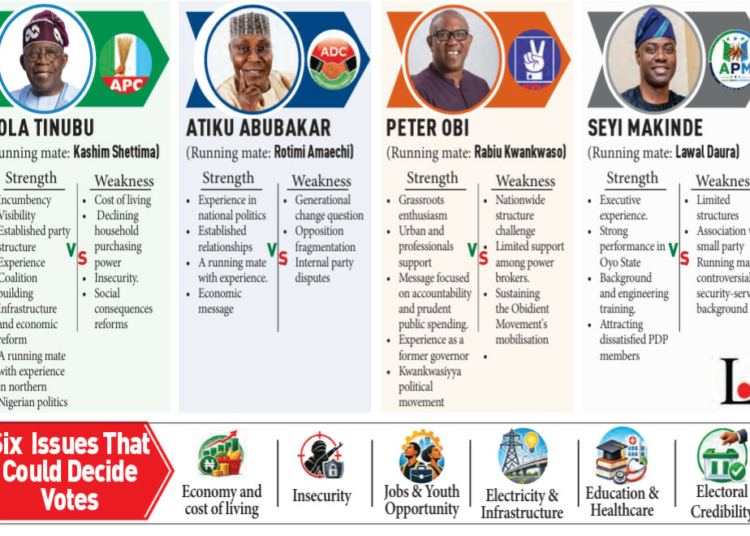
Nigeria’s 2027 presidential election is shaping up to be a fierce political contest, with President Bola Ahmed Tinubu, former Vice President Atiku Abubakar, former Anambra State Governor Peter Obi and Oyo State Governor Seyi Makinde among the prominent contenders seeking the nation’s top political office.
With just 60 days to the January 16, 2027 election, political activities are gathering momentum as candidates intensify campaigns, opposition parties explore possible alliances and Nigerians prepare to decide the country's next president.
The contest is expected to test the popularity of Tinubu’s administration and the ability of opposition politicians to unite behind a credible alternative.
According to a report by LEADERSHIP, the election will feature 18 presidential candidates cleared by the Independent National Electoral Commission (INEC), although the race is increasingly centred on the major political figures.
Tinubu, the All Progressives Congress (APC) candidate, enters the contest with the advantage of incumbency, an established nationwide political structure and experience in managing the federal government.
His administration is expected to campaign on economic reforms, infrastructure development and efforts to strengthen government revenue. However, rising living costs, insecurity and declining household purchasing power remain major challenges facing his re-election bid.
Atiku Abubakar, contesting under the African Democratic Congress (ADC), is banking on his extensive political experience and nationwide political networks.
With former Rivers State Governor Rotimi Amaechi as his running mate, Atiku is promising economic restructuring, job creation, industrialisation and institutional reforms.
However, internal party disputes, opposition fragmentation and a recent Federal High Court judgment nullifying his candidacy have introduced uncertainty into his campaign.
Former Anambra State Governor Peter Obi, presidential candidate of the Nigeria Democratic Congress (NDC), is seeking to build on his strong performance in the 2023 election.
Obi, who has former Kano State Governor Rabiu Musa Kwankwaso as his running mate, enjoys considerable support among young Nigerians, professionals and members of the Obidient Movement.
His campaign focuses on accountability, prudent public spending, investment, education, healthcare and economic productivity.
However, his major challenge remains converting popular enthusiasm into a strong nationwide political structure.
Oyo State Governor Seyi Makinde, who is contesting under the All Progressives Movement (APM), is also positioning himself as a major opposition figure.
With former Department of State Services Director-General Lawal Daura as his running mate, Makinde is banking on his executive experience, political influence in the Southwest and possible alliances with other opposition parties.
Other notable contenders include Adewole Adebayo of the Social Democratic Party (SDP), Omoyele Sowore of the African Action Congress (AAC), Gbenga Olawepo-Hashim of Accord, Donald Duke of the Peoples Redemption Party (PRP) and Sandy Onor of the Peoples Democratic Party (PDP).
Their chances, however, could be affected by limited nationwide political structures, internal party disagreements and difficulties in building broad electoral coalitions.
Key Issues That Could Decide The Election
Beyond the candidates and political parties, the election is expected to revolve around issues affecting the daily lives of Nigerians.
These include the economy and cost of living, insecurity, unemployment, electricity supply, infrastructure, education, healthcare and the credibility of the electoral process.
Meanwhile, efforts to unite opposition parties behind a single presidential candidate remain ongoing, with political observers watching whether such an alliance can emerge before election day.
APC, NDC, APM Express Confidence
Despite the challenges, the ruling APC has expressed confidence in securing victory.
The party's presidential campaign council spokesperson, Dele Alake, said its confidence was based on Tinubu's achievements, nationwide political structures and the administration's economic reforms.
He also dismissed claims that incidents involving the destruction of APC campaign materials and alleged booing of the president at the Jos rally reflected widespread rejection of the ruling party.
The NDC, however, insists it is strong enough to defeat the APC without necessarily depending on an opposition coalition.
Its National Publicity Secretary, Osa Director, said the party had covered more states and conducted more town hall meetings than other political parties.
Similarly, the APM expressed optimism that its presidential candidate, Makinde, could emerge as a consensus opposition candidate through ongoing discussions with the ADC and NDC.
With the election drawing closer, the battle for Nigeria's presidency is expected to intensify, as candidates seek to convince voters that they have the experience, policies and political strength to lead the country.