NDLEA Mobilises Edo Communities Against Drug Abuse, Seeks Stronger Collaboration
The National Drug Law Enforcement Agency (NDLEA) has called on traditional rulers, religious leaders, parents, schools, security agencies and community-based organisations in Edo State to intensify efforts to combat drug abuse and trafficking.
The agency said tackling the growing menace requires a collective approach that goes beyond arrests and seizures to include prevention, treatment, rehabilitation and reintegration of affected persons.
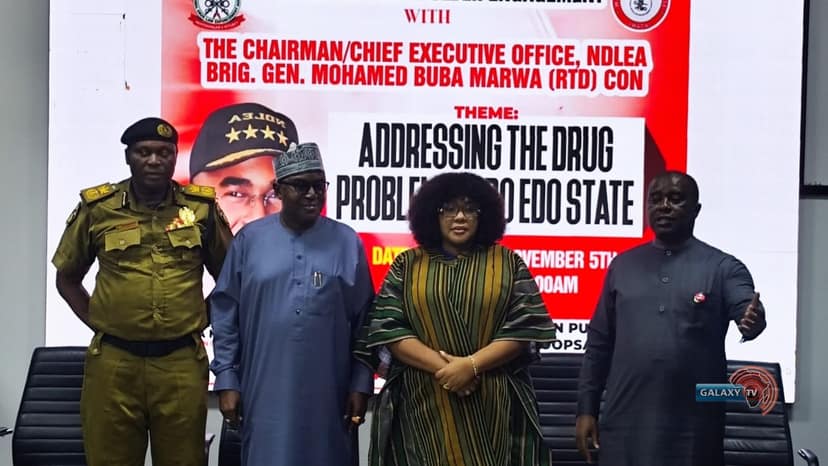
The Chairman and Chief Executive Officer of NDLEA, retired Brig.-Gen. Mohamed Buba Marwa, made the appeal during a stakeholders’ engagement in Benin City, where he raised concerns over the prevalence of substance abuse in the state.
Marwa disclosed that about 15 per cent of Edo residents aged between 15 and 64 were involved in drug abuse, translating to approximately one in every seven persons.
Although the figure is lower than Lagos State's 33 per cent prevalence rate, he described it as unacceptable, particularly given Edo's position as a cannabis-producing, consuming and transit state.
He further revealed that the NDLEA Edo Command arrested more than 1,200 suspects and seized over 30 tonnes of illicit drugs in 2025.
Highlighting the devastating consequences of substance abuse, the agency's Director of Media and Advocacy, Femi Babafemi, narrated the story of Abraham, a Benin-born young man who spent 10 years living on the streets after becoming addicted to illicit substances.
According to Babafemi, Abraham's ordeal began in childhood when a supposed spiritual mentor introduced him to cannabis. He subsequently progressed to opioids and became dependent on injectable pentazocine.
Abraham is now rebuilding his life after three years of recovery support from the NDLEA and its partners.
Marwa said the experience demonstrated why the fight against drug abuse must involve families, religious institutions, traditional authorities, schools, the media and civil society.
"We cannot do it alone. It is a whole-of-society approach. All the stakeholders must join hands, work together, collaborate and defeat this criminality," he said.
The NDLEA Edo State Commander, Dr Mitchell Ofoyeju, said the engagement was organised to review existing interventions, identify gaps and strengthen intelligence sharing and community participation in prevention, enforcement and rehabilitation.
Also speaking, the Coordinator of the Office of the Wife of the Edo Governor and Chairperson of the Edo State Drug Control Committee, Edesili Okpebholo-Anani, expressed concern over the increasing impact of substance abuse on children, women and families.
She highlighted the economic consequences of drug dependence, warning that affected families often suffer financial hardship and reduced productivity.
Okpebholo-Anani also advocated alternative livelihood programmes for cannabis farmers whose farms are destroyed during enforcement operations, saying they should not be left without sources of income.
She disclosed that the Edo Government was interested in adopting an alternative development and sustainable livelihood programme piloted in Ondo State.
Marwa said the NDLEA was already encouraging cannabis farmers to embrace legitimate agricultural activities, including rice, cassava, beans and cocoa cultivation.
On prevention, the NDLEA Director of Prevention and Sensitisation, Abubakar Garba, urged religious leaders, traditional rulers and parents to use their influence to discourage drug consumption.
He also highlighted the agency's War Against Drug Abuse (WADA) initiative, which promotes community-based sensitisation.
Marwa urged parents to monitor changes in their children's behaviour, while calling on schools to establish drug-free clubs and counselling units.
He also appealed to the media to avoid glorifying substance abuse through the promotion of entertainers and public figures associated with illicit drug use.
Babafemi, meanwhile, called on civil society organisations to help eliminate the stigma surrounding substance use disorders.
"Help us remove stigma because shame kills more quietly than even the drugs," he said.
He disclosed that the agency operates a 24-hour toll-free helpline, 0800 10 20 30 40, staffed by clinical psychologists, psychotherapists and psychiatric doctors to provide guidance and referrals.
The NDLEA Director of Counselling, Treatment and Rehabilitation, Ibrahim Bashir, stressed that drug dependence should be treated as a health challenge rather than a moral failure.
He explained that the agency's intervention framework covers prevention, counselling, treatment, rehabilitation, reintegration and skills acquisition.
Bashir also noted that relapse could be part of the recovery process, making sustained support and follow-up essential.
Marwa disclosed that the NDLEA operates 31 rehabilitation centres nationwide, including one in Edo, and appealed to the state government to establish another facility to improve access to treatment.
The security implications of drug abuse also featured prominently at the engagement.
The Commander of the Nigerian Army's 4 Brigade, Brig.-Gen. Ahmed Balogun, described drug abuse and insecurity as interconnected challenges.
"Drug abuse and insecurity are twins. There is a nexus between the two. One feeds the other," he said, pledging continued cooperation between the Army and the NDLEA.
Marwa further disclosed that the agency was collaborating with the Federal Road Safety Corps to institutionalise drug testing for commercial drivers, warning that substance abuse among transport operators endangered passengers and other road users.
He urged transport unions to discourage drug and alcohol consumption in motor parks.
The NDLEA chairman also revealed that a proposed amendment to the agency's Act had passed second reading at the National Assembly. The bill seeks to introduce prison terms of between 15 and 25 years, while removing the option of fines for specified offences.
The proposed amendments are still subject to the legislative process.
Marwa also disclosed that he had visited the Oba of Benin and sought the monarch's support in mobilising traditional institutions against drug abuse and trafficking.
The engagement reinforced the need for a comprehensive strategy that combines law enforcement with community sensitisation, accessible rehabilitation services and sustainable livelihood opportunities.
The NDLEA maintained that the success of the campaign would ultimately be measured not only by arrests and drug seizures but also by the number of young people protected, families supported and lives successfully restored.